
The robotics workforce gap is widening. Pending retirements combined with insufficient trained workers could leave millions of manufacturing and technology jobs unfilled in the coming years. For university leaders, this presents both a challenge and an opportunity. Institutions that integrate robotics into their academic programs position graduates for careers in automation, AI, and advanced manufacturing. Those that don't risk producing students unprepared for a labor market transformed by intelligent machines.
The global robotics market is projected to exceed , fueled by AI advances, labor shortages, and widespread automation. Universities are responding. Carnegie Mellon launched an . Johns Hopkins now offers an for working professionals. These programs aim to produce graduates who can analyze, design, build, and deploy robotic systems across industries.
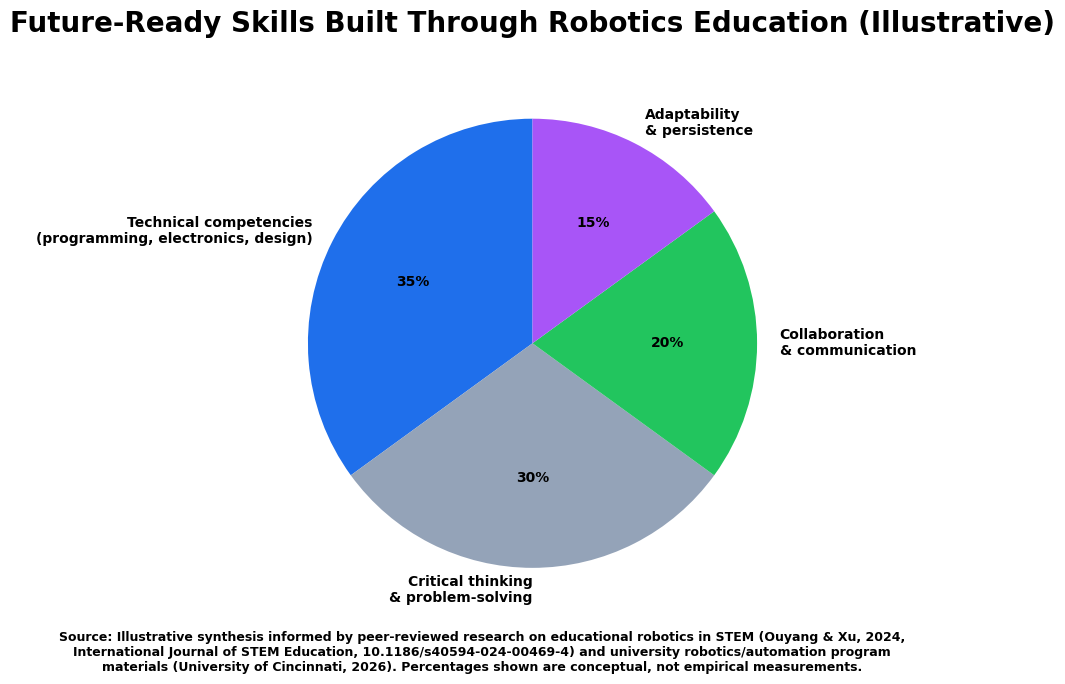
But what does "future-ready" actually mean? It means students who possess technical competencies alongside critical thinking, collaboration skills, and adaptability. Robotics education delivers on all fronts.
The Research Case for Robotics in STEM
The evidence supporting robotics education is substantial. A multilevel meta-analysis examining studies from 2010 to 2022 found that educational robotics produces compared to traditional instruction. Students showed improved learning performance and stronger attitudes toward STEM subjects.
Why does robotics work? It makes abstract concepts tangible. When students design, build, and program robots, they apply theoretical knowledge in ways that strengthen retention and . The field integrates into unified learning experiences. Students don't just study these disciplines in isolation. They see how they connect.
Robotics also builds the soft skills employers demand. Team-based projects require communication and collaboration. Debugging a malfunctioning robot builds persistence and . Competition environments add pressure that mimics real-world deadlines and constraints.
What Robotics Education Looks Like Today
University robotics programs vary widely in structure and focus. Some offer dedicated degrees. Others integrate robotics into existing engineering curricula through concentrations or minors.
The University of Michigan-Dearborn's BSE in Robotics Engineering blends in AI, cloud computing, and nanotechnology. Students choose from three dozen options, tailoring the program to their interests. The University of Cincinnati recently unveiled a equipped with industrial-grade robotic arms, programmable logic controllers, and simulation software.
Hands-on experience is non-negotiable. Widener University integrates that allow students to complete eight months of professional experience within a four-year degree. WSU Tech's program, developed with Wichita State University, earned ARM Institute endorsement for courses aligned with .
Competitions play a significant role. FIRST Robotics and VEX provide that builds technical skills alongside teamwork and resilience. Carnegie Mellon's SMART program partners with to align competition activities with workforce credentials. Research shows competition participation correlates with higher among participants.
Robots as Instructors
Robotics isn't just something students learn about. Robots are increasingly doing the teaching.
Germany's Philipps University of Marburg introduced that acts as a teaching assistant during lectures. Research at the University of Wuerzburg found in higher education exam preparation. India deployed "Iris," a that delivers educational content and offers personalized voice assistance.
AI-powered tutoring systems are gaining traction in U.S. institutions. Georgia State University uses "Pounce," a chatbot supporting . These systems provide that adapts to individual learning styles and paces. They can handle like grading and progress tracking, freeing faculty for higher-value interactions.
The limitations are real. Students still prefer human guidance for . Ethical concerns remain around data privacy and the risk of . Robots supplement rather than replace faculty. The goal is augmentation, not substitution.
Aligning Curriculum with Workforce Needs
The disconnect between academic training and employer expectations has long frustrated both sides. Robotics programs are working to close that gap.
The ARM Institute collaborates with manufacturers to define for robotics roles. Carnegie Mellon's SMART program developed in robotics integration, electrical foundations, and autonomy based on research involving industry professionals. These credentials signal to employers that graduates possess specific, validated skills.
Nebraska Innovation Studio offers through a three-day hands-on program. Participants learn robot programming, operation, troubleshooting, and optimization. Community college partnerships create with waived credits for aligned curricula, reducing time and cost for students.
What do employers want? Technical proficiency in programming languages like Python and C++, familiarity with , and experience with sensors and actuators. But soft skills matter equally. Teamwork, communication, and adaptability are across the industry.
The Challenges You'll Face
Implementing robotics education isn't simple. University leaders should anticipate several barriers.
Cost tops the list. Advanced robotic systems can be , particularly for institutions with limited budgets. Two primary barriers hinder widespread adoption: . Ongoing funding is needed for maintenance, professional development, and .
Faculty readiness presents another hurdle. Educators must acquire to effectively integrate robotics into teaching. Resistance from faculty and students presents . Faculty development programs and exchange opportunities can , but they require investment and institutional commitment.
Equity concerns deserve attention. High costs may widen the between well-funded and under-resourced institutions. Shared resources like mobile labs can to multiple schools. Industry partnerships can offset costs by .
Learning from Global Leaders
U.S. institutions can learn from international models that have invested heavily in robotics education.
Japan has led . The University of Tokyo remains at the forefront of humanoid robotics research. Tohoku University's robotics department features working on MEMS technology and intelligent control systems. Close ties between universities and companies like Fanuc and Yaskawa provide unavailable elsewhere.
Germany combines engineering tradition with accessible education. Technical University of Munich offers featuring strong industry partnerships. Public universities provide , attracting international students. Partnerships with Volkswagen, ABB, and other manufacturers create that integrate academic learning with professional experience.
Singapore has emerged as an innovation hub. The National University of Singapore's Advanced Robotics Centre develops . The city-state's supportive policies and make it attractive for students seeking careers in automation and AI.
Strategic Recommendations

For university leaders considering robotics integration, several strategies can improve outcomes.
Start with pilot programs. Begin with targeted courses or labs before scaling to full degree programs. This approach limits risk while generating data on student interest and learning outcomes. Partner with industry early to secure equipment, mentorship, and curriculum input.
Build faculty capacity. Invest in professional development for existing faculty rather than relying solely on new hires. Establish collaborations with research universities for faculty exchange. Consider hiring instructors with industry experience who can bring practical knowledge into the classroom.
Pursue sustainable funding. Seek partnerships with local businesses and tech companies for . Explore grants from the National Science Foundation and . Subscription models for robotics equipment can while maintaining access to current technology.
Design for inclusion. Create programs that attract to robotics fields. Provide scholarships for students from under-resourced backgrounds. Use collaborative robots (cobots) that are for students with limited prior experience.
The Bottom Line
The ARM Institute describes a threatening U.S. manufacturing security and resiliency. Universities play a central role in addressing it.
Robotics education works. The research demonstrates its impact on learning outcomes, student engagement, and workforce preparation. The challenges of cost and training are real but surmountable through partnerships, grants, and phased implementation.
Students who graduate with robotics competencies enter a job market hungry for their skills. They can pursue careers in engineering, programming, healthcare robotics, advanced manufacturing, and dozens of other fields. Those without such preparation face a narrower range of options in an increasingly automated economy.
For university leaders weighing this investment, the question isn't whether robotics matters. It's whether your institution will be part of the solution or left behind as others move forward.
 Undergraduate Research: How Students Join Labs Across Campus
 Using AI to Succeed in College Science Courses
 What Steps Should You Take to Become a University Tutor?
 How to Balance Work and Academics Without Falling Behind
 How Faculty Mentor Students Through Independent Study Projects