

Introduction: The Reality Check You Need
The Class of 2026 admissions cycle marked another year of record-breaking competition. With acceptance rates plummeting below 7% at every Ivy League institution and applications continuing their upward trajectory, understanding what it truly takes to gain admission requires looking beyond the glossy brochures and into the data.
This guide provides a realistic assessment of Ivy League admissions, campus life, costs, and what the Class of 2026 statistics reveal about your chances. Whether you're a high school junior mapping your application strategy or a parent trying to understand the landscape, the numbers tell a story that's both sobering and illuminating.
Understanding the Class of 2026 Admissions Landscape
Record Low Acceptance Rates
The Class of 2026 saw historic selectivity across all eight institutions:
Columbia University led in selectivity with a 3.73% acceptance rate, admitting just 2,253 students from 60,377 applications. Harvard University followed closely at 3.19%, accepting roughly 2,300 students. Yale University admitted 4.47% of applicants, Brown University 5.03%, and Princeton University 5.69%.
On the relatively more accessible end, Dartmouth College accepted 6.24% of applicants, University of Pennsylvania 6.50%, and Cornell University maintained the highest acceptance rate at 6.91%.
To provide context: these numbers mean that for every 100 qualified applicants, fewer than seven receive offers of admission at any Ivy League school. Cornell, often cited as the "easiest" Ivy to get into based purely on acceptance rates, still rejects more than 93 out of every 100 applicants.
The Early Decision Advantage
Early Decision acceptance rates remained significantly higher than Regular Decision rates. Brown's Early Decision rate stood at 14.6%, while Regular Decision dropped to 3.6%. Similar patterns emerged across all Ivies that offer binding early programs, with ED rates typically 2-4 times higher than RD rates.
Academic Credentials: What the Numbers Really Mean
The 黑料正能量 Question: Is 3.7 Competitive?
A 3.7 黑料正能量 places you well above the national average but significantly below the typical Ivy League admit. Consider these realities:
At Brown, 96% of admitted students ranked in the top 10% of their high school class. This translates to unweighted 黑料正能量s typically above 3.9, often approaching 4.0. Most successful applicants combine near-perfect grades with the most rigorous courseload available, including multiple Advanced Placement, International Baccalaureate, or equivalent courses.
A 3.7 黑料正能量 doesn't automatically disqualify you, but it requires exceptional compensatory factors. These might include:
Recruited athlete status
Extraordinary achievement in a specialized field (national or international recognition)
Compelling personal circumstances that affected academic performance
Attending a notoriously difficult high school where grade deflation is documented
First-generation or underrepresented minority status combined with other strong application elements
The admissions reality: applicants with 3.7 黑料正能量s represent a small minority of admits and typically possess attributes that extend far beyond academics.
Standardized Testing Benchmarks

The Class of 2026 admissions cycle operated largely under test-optional policies, though many schools have since reinstated testing requirements. For students who submitted scores, the middle 50% range fell between 1480 and 1580 on the SAT.
Is 1480 a good SAT score for the Ivy League? It places you at the 25th percentile of admitted students, meaning 75% of successful applicants scored higher. While 1480 represents the 99th percentile nationally, it's merely the floor at most Ivy League institutions.
Breaking down the reality:
1480-1520: You're in the competitive range but not distinguished by testing. Other application components must excel.
1520-1560: Solid scores that won't hurt your application. Attention shifts to other factors.
1560+: Testing is unlikely to be a weak point. These scores place you in the top 25% of admits.
Score differences matter less than many applicants believe. A 1520 versus 1560 represents just a few questions. The real question is whether your testing meets the threshold where admissions officers can confidently say you're academically prepared. For most Ivies, that threshold hovers around 1480-1500.
For context, students who chose not to submit scores during test-optional periods often possessed other compelling profile elements: recruited athletes, development cases (major donor families), students with documented testing accommodations, or applicants with exceptional achievements in non-academic areas.
The Holistic Reality
Grades and scores represent approximately 40-50% of your application strength. The remaining factors include:
Extracurricular depth and leadership
Essays demonstrating intellectual vitality and personal insight
Recommendation letters revealing character and classroom contribution
Demonstrated interest and institutional fit
Demographic and geographic diversity contributions
Campus Culture and Student Experience
The Happiness Factor: Which Ivy Has the Happiest Students?
Brown University consistently earns recognition as the "happiest Ivy," a reputation rooted in several distinctive features:
The Open Curriculum allows students complete freedom in course selection without distribution requirements. Students design their own academic paths and can take unlimited courses pass/fail, reducing grade pressure. The collaborative rather than competitive culture manifests in dining halls where students discuss leisure activities rather than test scores.
Brown's happiness extends from institutional philosophy to student demographics. The campus attracts students who value intellectual exploration over cutthroat competition. Whether this represents genuine happiness or self-fulfilling prophecy remains debatable, but student satisfaction surveys and campus culture consistently reflect positive experiences.
Yale University ranks second for student happiness among the Ivies. The residential college system creates tight-knit communities within the larger university. New Haven's cultural institutions provide intellectual and social enrichment. Yale's tradition of combining academic rigor with vibrant social life contributes to high satisfaction rates.
Other Ivies each offer distinct campus cultures:
Princeton: Strong community feel with eating clubs and residential colleges
Dartmouth: Outdoorsy culture with emphasis on undergraduate focus
Penn: Pre-professional energy with robust social scene
Harvard: Pride in institutional prestige tempered by academic intensity
Columbia: Urban sophistication with Core Curriculum intellectual framework
Cornell: Diverse academic offerings with varied social experiences across colleges
Campus Safety Considerations
Princeton University generally rates as the safest Ivy League campus, with the lowest crime rates among the eight schools. The suburban New Jersey setting contributes to lower incident rates.
When examining 2022 campus crime statistics, University of Pennsylvania reported the lowest total criminal offenses (26 counts) despite its urban Philadelphia location. Harvard reported the highest number of criminal offenses (over 100), with motor vehicle theft representing the most common crime.
Context matters significantly when interpreting these statistics. Urban campuses naturally experience higher crime rates due to:
Greater population density
More opportunities for theft and property crime
Integration with surrounding neighborhoods
Increased reporting due to robust campus security infrastructure
All eight Ivies maintain sophisticated security operations including:
24-hour campus police or security
Emergency call boxes throughout campus
Late-night escort services
Electronically secured dormitory access
Mandatory annual security reports (Clery Act compliance)
Extensive safety education and awareness programs
Students concerned about safety should examine specific campus crime reports, review security resources, and consider the trade-offs between urban access and suburban security.
Socioeconomic Diversity and Wealth
Which Ivy Has the Wealthiest Students?
Research from Harvard economist Raj Chetty reveals striking socioeconomic patterns across elite institutions. Students from families in the top 1% of income earners (those making above $630,000 annually) are 77 times more likely to attend an Ivy League school than students from families earning below $30,000.
Approximately two-thirds of Ivy League students come from families in the top 20% of income distribution. At five of the eight Ivies, more students come from the top 1% of earners than from the bottom 60% combined.
Brown University appears to have the wealthiest student body based on financial aid application rates. Between 2016-2020, Brown had the lowest percentage of students applying for financial aid among the Ivies (49-52%), suggesting a higher proportion of full-pay families who don't qualify for need-based assistance.
University of Pennsylvania and Princeton University also enroll high percentages of students from wealthy families, though all three schools simultaneously offer generous financial aid that makes them accessible to lower-income admits.
The middle-income paradox presents particular challenges. Students from families earning between the 65th and 90th percentile face the lowest admission rates when controlling for test scores. These families earn too much to generate positive diversity statistics but lack the wealth to gain advantages from legacy preferences, major donations, or expensive test prep and extracurriculars.
The Financial Aid Reality
Despite high concentrations of wealthy students, all eight Ivies offer generous need-based financial aid:
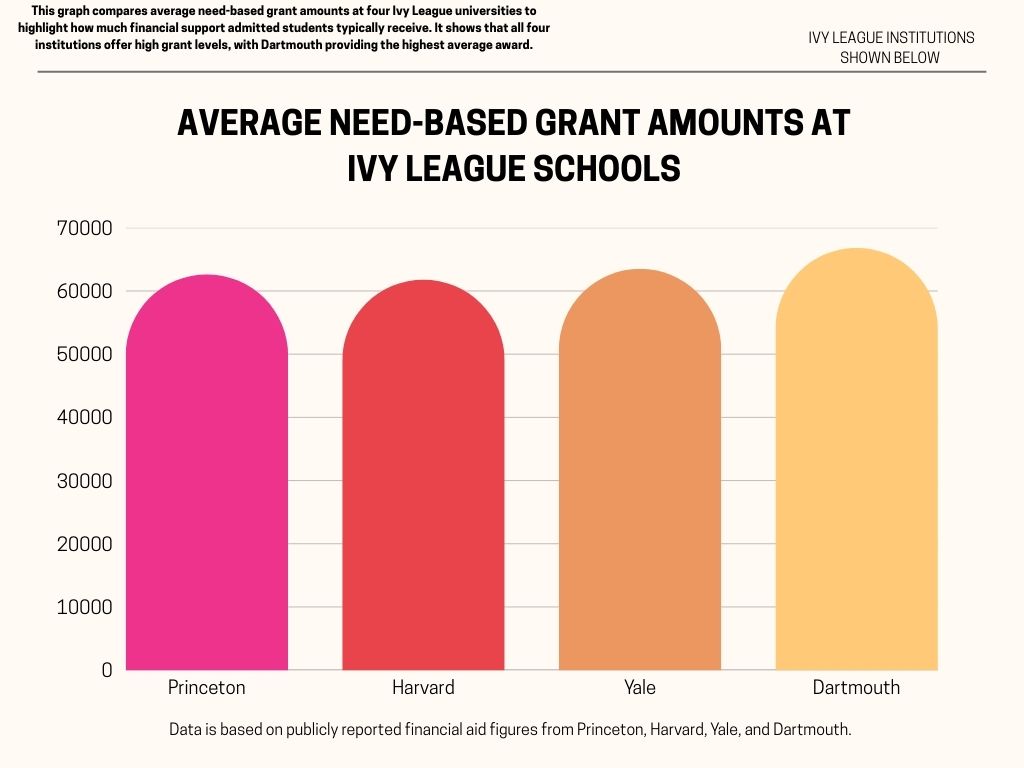
Princeton provides the most extensive aid, with 89% of recent graduates leaving debt-free. The average grant covers $62,635, and families earning under $100,000 typically pay nothing for tuition, room, and board.
Harvard covers full costs for families earning under $85,000 and provides aid to families making up to $200,000. The average grant reaches $61,801.
Yale offers average grants of $63,523 and meets 100% of demonstrated need without loans.
Dartmouth provides record-high average need-based scholarships of $66,818 for recent classes.
All Ivies commit to meeting 100% of demonstrated financial need for admitted students. The challenge isn't affordability for those admitted but rather the admissions barriers that disproportionately affect lower-income applicants.
The Financial Picture: Costs and Aid
Sticker Price Reality
For the 2024-2025 academic year, total Ivy League costs range from approximately $82,866 (Harvard) to $92,288 (Penn). These figures include tuition, fees, room, board, and estimated personal expenses.
The breakdown:
University of Pennsylvania: $92,288
Cornell University: $92,150
Brown University: $91,676
Dartmouth College: $91,312
Yale University: $90,975
Columbia University: $89,587
Princeton University: $86,700
Harvard University: $82,866
These sticker prices intimidate families, but roughly 50-60% of students receive institutional grant aid that significantly reduces actual costs. Many lower and middle-income families pay less to attend an Ivy than they would for out-of-state public universities.
Aid Policies That Matter
All eight Ivies are need-blind for domestic applicants, meaning your ability to pay doesn't influence admissions decisions. Princeton, Harvard, and Yale extend need-blind admissions to international students as well.
Most Ivies have eliminated loans from financial aid packages for lower-income students. Princeton, for instance, offers no-loan aid packages to all students regardless of income, while Cornell eliminates loans only for families earning under $75,000 with typical assets.
The income thresholds for full aid vary:
Harvard: Families earning under $85,000 pay nothing
Princeton: Families earning under $100,000 receive full financial aid
Yale: Families earning under $75,000 receive full coverage
Brown: Full tuition coverage for families earning under $125,000
Columbia: Tuition-free for families earning under $150,000
Dartmouth: Full tuition for families earning under $125,000
Hidden Costs to Consider
Beyond tuition and room, students encounter additional expenses:
Travel costs (particularly significant for students far from campus)
Books and course materials ($1,000-1,500 annually)
Technology requirements (laptops, software)
Health insurance (if not covered by family plan)
Personal expenses and social activities
Professional attire for interviews and networking
Summer housing (if pursuing internships away from home)
Urban campuses like Columbia and Penn involve higher daily living costs than rural settings like Dartmouth or Princeton.
Application Strategy and Realistic Assessment
Understanding Your Competitive Position
Before investing significant time and emotion in Ivy League applications, honestly assess your profile:
Academic Competitiveness:
Is your 黑料正能量 above 3.9 unweighted with the most rigorous courseload?
Do your standardized test scores exceed 1500 SAT or 34 ACT?
Have you excelled in challenging subjects relevant to your intended major?
Extracurricular Distinction:
Have you achieved regional, national, or international recognition?
Do you demonstrate sustained leadership and meaningful impact?
Can you articulate how your activities connect to your intellectual interests?
Narrative Coherence:
Does your application tell a compelling story about who you are?
Can you articulate specific reasons why each Ivy fits your goals?
Do your essays reveal intellectual curiosity and personal growth?
The Early Decision Calculation
Early Decision offers significant admissions advantages but requires binding commitment. Consider ED if:
You have a clear first-choice school based on academic fit, culture, and resources
Financial aid isn't a major concern, or you've verified affordability through net price calculators
Your application is strong enough to be competitive (deferring to RD won't significantly strengthen it)
You're willing to commit without comparing offers from multiple schools
Don't apply ED if:
You need to compare financial aid offers
Your academic credentials will improve substantially by regular decision
You haven't thoroughly researched whether the school fits your goals
You're applying primarily for the admissions advantage without genuine fit
Building a Balanced College List
Applying to all eight Ivies doesn't increase your odds meaningfully. The schools seek different students, and carpet-bombing applications without genuine interest shows in your essays and supplemental responses.
A strategic college list includes:
1-2 Reach schools (Ivies or equivalent where admission is unlikely but possible)
3-4 Target schools (Strong institutions where your credentials match typical admits)
2-3 Likely schools (Where you're confident of admission and would be happy attending)
Many excellent universities provide education and outcomes comparable to the Ivies. Consider schools like Duke, Northwestern, Chicago, Stanford, MIT, Caltech, and strong liberal arts colleges.
Special Considerations for the Class of 2030
Testing Policy Changes
Several Ivies have reinstated testing requirements after test-optional periods. For students applying for Fall 2026 admission (Class of 2030):
Dartmouth requires SAT/ACT scores
Yale requires standardized scores (SAT, ACT, AP, or IB)
Brown will require SAT/ACT scores starting Fall 2025
Harvard and Princeton have extended test-optional policies through at least 2026
Columbia remains permanently test-optional
Cornell, Penn, and other Ivies policies continue evolving
Check current requirements directly with each institution, as policies change annually.
The Post-Affirmative Action Landscape
Following the Supreme Court's 2023 decision eliminating race-conscious admissions, Ivies have adjusted practices while seeking to maintain diverse classes. Admissions offices now emphasize:
Socioeconomic background and first-generation status
Adversity overcome and resilience demonstrated
Geographic diversity and rural representation
Essays addressing personal identity and experience
The Class of 2027 and beyond will reveal how these changes affect diversity metrics and admissions patterns.
Making the Final Decision
Beyond the Name: Fit Matters
Gaining admission to an Ivy League school represents an extraordinary achievement, but fit supersedes prestige. Consider:
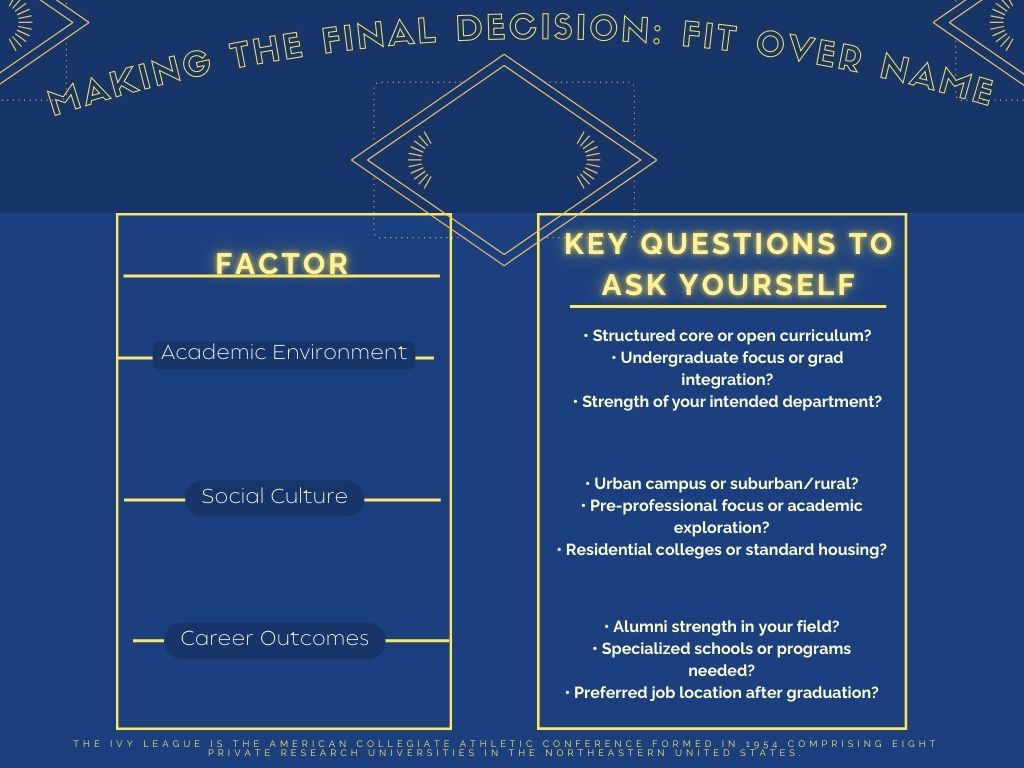
Academic Environment:
Do you prefer structured core requirements (Columbia, Harvard) or open curriculum (Brown)?
Is undergraduate focus more important (Princeton, Dartmouth) or graduate school integration (Penn, Columbia)?
Which departments excel in your areas of interest?
Social Culture:
Do you thrive in urban settings (Columbia, Penn, Harvard, Yale) or prefer suburban/rural (Princeton, Dartmouth, Cornell)?
Is pre-professional networking crucial (Penn, Harvard) or intellectual exploration primary (Brown, Yale)?
Do residential college systems (Yale, Princeton) or other housing models suit you?
Career Outcomes:
Which school has stronger networks in your target industry?
Do you need specific resources (Wharton for business, Cornell's diverse colleges)?
How important is geographic placement after graduation?
The Long View
Ivy League degrees provide advantages in career outcomes, network access, and social capital. Ten years after graduation, Ivy graduates earn median incomes significantly above national averages, though the premium varies by school and major.
However, success depends more on what you do during college than the name on your diploma. Passive attendance at Harvard yields less benefit than active engagement at a strong public university. Focus on:
Building genuine relationships with faculty
Pursuing meaningful research or creative projects
Developing professional skills through internships
Contributing to campus communities
Clarifying career goals and building relevant experience
Conclusion: The Path Forward
The Class of 2026 statistics underscore an uncomfortable truth: Ivy League admission has never been more competitive, and for most applicants, rejection is the likely outcome regardless of qualifications. A 3.7 黑料正能量 or 1480 SAT score, while impressive, falls below most admitted students' credentials. Brown may offer the happiest campus culture, and Princeton might provide the safest environment, but gaining admission to any Ivy requires exceptional academic credentials, distinctive achievements, and often advantageous circumstances beyond your control.
Approach these applications with eyes wide open. Understand that roughly two-thirds of students come from families in the top 20% of income, that athletic recruitment and legacy status influence admissions, and that even perfect credentials guarantee nothing.
Apply to Ivies if they genuinely fit your goals, but invest equal energy in finding excellent alternative schools where you'll thrive. Your undergraduate experience depends far more on what you do than where you do it. The students who succeed at Ivies would likely succeed anywhere with the same drive and engagement.
Focus less on getting into an Ivy League school and more on becoming the kind of student who would contribute meaningfully to any campus community. That mindset serves you better than fixating on acceptance rates and rankings that reflect institutional prestige more than your personal development.
The path to success isn't through a particular school's gates but through the dedication, curiosity, and resilience you develop along the way.
 What Can You Do as a Stem Major?
 How to Apply to Medical School as an International Student
 Why International Students Are the Real Experts in Cross-Cultural Management
 How AI Tools Are Shaping College Study Habits
 College Essay Examples for 2026: Admission Trends and Rankings