

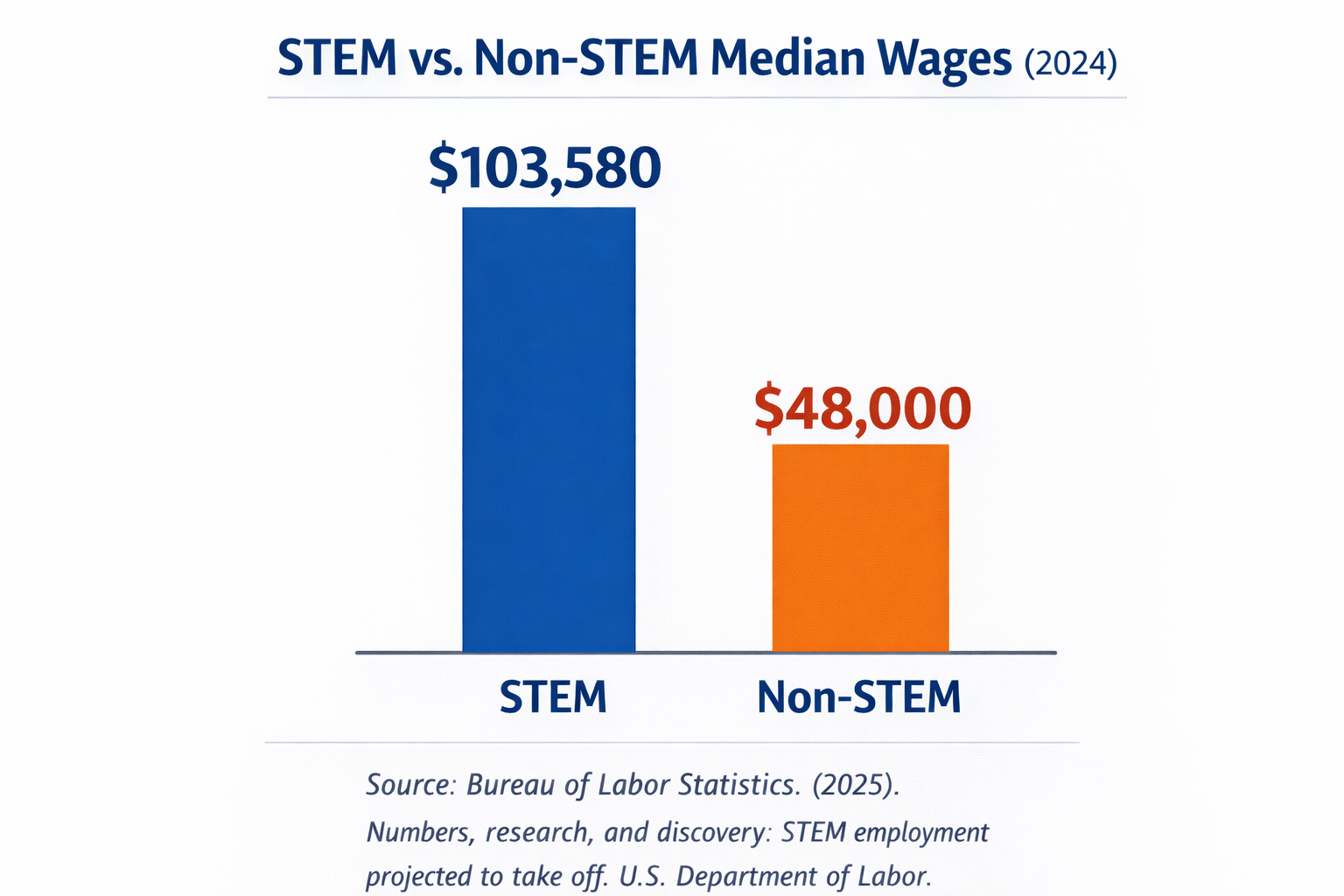
So you're in a STEM program or you just graduated. Now what? Understanding what you can do as a STEM major is the first step toward making a smart next move. The short answer: a lot. STEM careers span software development, engineering, data science, healthcare, research, and dozens of specialized fields. The for STEM occupations hit $103,580 in 2024, more than double the $48,000 median for non-STEM jobs.
Below, I'll walk you through what's actually out there, where the money is, whether grad school makes sense for you, and how to figure out your own version of a good career.
Career Options by STEM Discipline
STEM careers cluster into four broad categories. Here's what each offers.
Technology and Computing
Tech roles dominate STEM job growth. Software development alone is to grow 15% through 2034. Key roles include:
Software developer: Median salary around $133,000. You build applications, systems, and platforms. This is one of the most common entry points for CS graduates.
Data scientist: of 34%, median pay $112,590. You analyze complex datasets to inform business decisions.
Information security analyst: of 29%, median around $125,000. You protect systems from cyber threats.
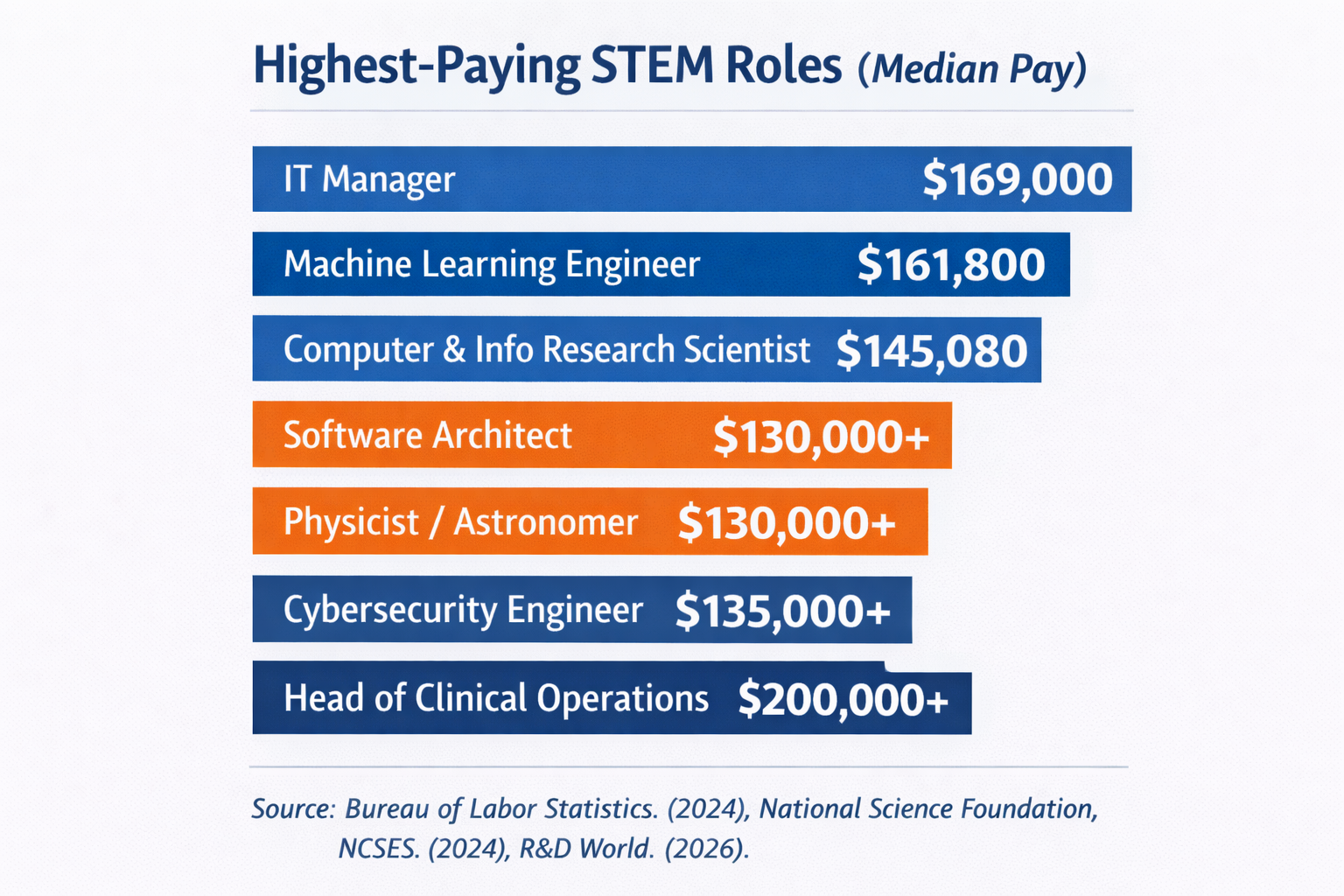
IT manager: Median salary over $169,000. You oversee technology operations for organizations.
Other roles include database administrators, network architects, and cloud engineers.
Engineering Fields
Engineering offers strong early-career wages and low unemployment. According to the , engineering majors earn early-career salaries of $70,000-$80,000, among the highest of any major.
Common paths include:
Mechanical engineer: Design and build physical systems, from HVAC to robotics. $102,320.
Electrical engineer: Work on circuits, electronics, and power systems.
Civil engineer: Plan infrastructure like bridges, roads, and water systems.
Software engineer: Overlaps with tech. You focus on system architecture and code.
About 51-52% of engineering and computer science majors stay in STEM occupations long-term, according to the . That's the highest retention rate among STEM disciplines.
Healthcare and Life Sciences
Life sciences often require advanced degrees, but the payoff is significant. Roles include:
Epidemiologist: 19% growth, median $81,390. You study disease patterns and public health data.
Biotech researcher: Work on drug development, genetic research, or medical devices.
Clinical operations roles: Senior positions like Head of Clinical Operations exceed $200,000.
Pre-med students with biology or chemistry degrees often get counted as "leaving STEM" when they become physicians. In reality, they're applying STEM skills in healthcare.
Pure Sciences and Math
These fields often lead to research, academia, or specialized industry roles.
Physicist/Astronomer: Median salary exceeds $130,000. Typically requires a doctoral degree.
Actuary: 22% growth, six-figure salaries. You assess risk for insurance and finance companies.
Environmental scientist: Work on climate, conservation, or regulatory compliance.
Mathematician/Statistician: Roles in government, research, and tech companies.
Pure science careers often require graduate education. Plan accordingly if this is your track.
Highest-Paying STEM Jobs
Highest-Paying STEM Jobs
If salary drives your decision, here's where the money is.
Role | Median Salary | Notes |
|---|---|---|
Machine Learning Engineer | $160,000+ | High demand at major tech firms |
$140,910 | 20% projected growth | |
Head of Clinical Operations | $200,000+ | Senior life sciences leadership |
$133,080 | 15% growth through 2034 | |
$124,910 | 29% growth | |
$112,590 | 34% growth | |
IT Manager | $169,000 | Oversees tech operations |
Geographic location matters. California, Washington, and New York lead in average STEM salaries but also have high living costs. Weigh net income, not just gross.
About 90 out of 100 STEM jobs pay above the national median wage. The floor is high even if you don't land a top-tier role.
Is a STEM Major Worth It?

Yes, but with caveats.
The Upside
STEM jobs are to grow 10.4% through 2033, compared to 4% for all occupations. Demand is strong in data science, cybersecurity, and AI-related fields.
STEM skills also transfer well. According to , 36% of STEM majors working in non-STEM jobs earn more than STEM majors in STEM jobs. Your degree earns a wage premium even if you switch fields. Economics majors, for example, often work as financial analysts or managers rather than as economists, and they earn more in those roles.
The Catch
Research from found that STEM majors earn more in their early 20s, but the advantage fades over time. Non-STEM peers catch up within a decade.
Why? STEM skills become outdated fast. The technologies you learn today may be obsolete in five years. To maintain your edge, you need ongoing education, whether through employer training, certifications, or graduate study.
The takeaway: a STEM degree is a strong start, not a permanent advantage. Continuous learning is part of the deal.
Work vs. Graduate School vs. Certifications
This is the decision most STEM students agonize over. Here's how to think about it.
When to Go Straight to Work
Go directly into the workforce if:
Your target role values skills and experience over credentials. Software development, data analysis, and IT fall into this category.
You want to test the field before committing to more education.
You need income now. Financial independence matters.
Your employer offers tuition reimbursement. Some companies pay for graduate degrees after you join.
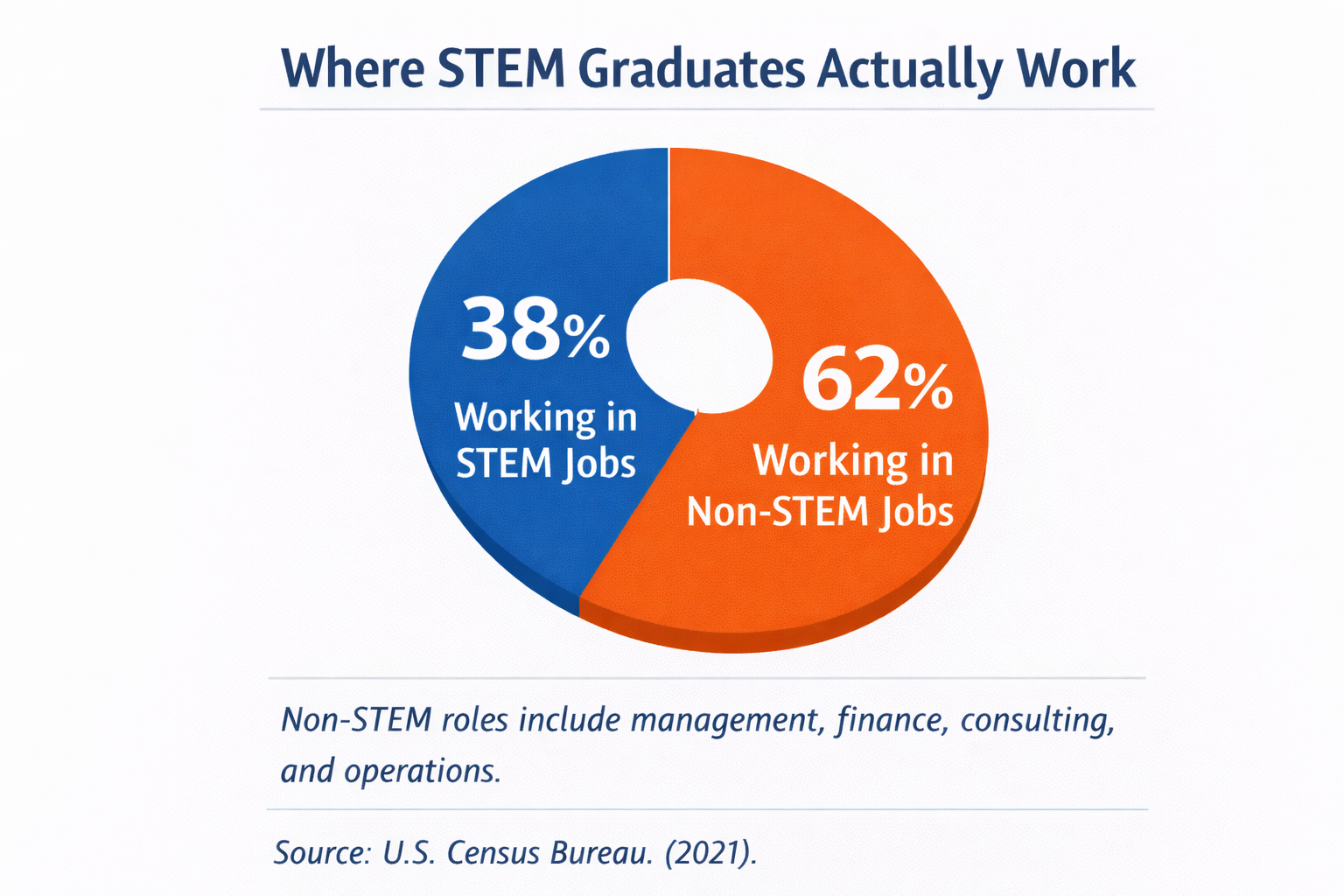
About 62% of STEM graduates work in non-STEM fields, often in management, finance, or business roles, according to the . Starting work gives you flexibility to pivot.
When Graduate School Makes Sense
Pursue a master's or PhD if:
Your target career requires it. Research, academia, and R&D leadership typically need advanced degrees.
You're in biotech, physics, or materials science. These fields often require graduate training.
You want higher long-term earnings. The reports that the median salary for STEM workers with advanced degrees is about $24,000 higher than for those without.
You're aiming for clinical or research director roles.
About 40% of STEM workers in STEM jobs hold a graduate degree. For certain tracks, it's expected.
MBA programs often prefer candidates with 4+ years of work experience. If business leadership is your goal, work first, then apply.
When Certifications Add Value
Certifications work well when:
You're pivoting within STEM (e.g., moving from development to cloud architecture).
You need to refresh skills without a full degree program.
Your field values specific credentials, such as AWS, Azure, PMP, or CISSP.
Certifications are faster and cheaper than degrees. They signal current skills to employers.
Defining "Best Career" for You
There's no universal "best" STEM career. It depends on what you value.
If salary is your priority: Target AI, machine learning, senior engineering, or data science roles. These consistently top the pay charts.
If job security matters: Information security, healthcare tech, and data science show strong projected growth. Epidemiology and public health roles also remain in demand.
If research appeals to you: Pursue graduate work. Academia, R&D, and government research roles require advanced degrees but offer intellectual depth.
If flexibility is key: Software development and data roles offer strong remote options.
If location matters: Boston, San Francisco Bay Area, and Austin remain top hubs for STEM jobs.
Think about your working style, too. Do you want to build things, analyze data, lead teams, or conduct research? STEM accommodates all of these, but the paths look different.
How to Position Yourself Now

How to Position Yourself Now
You can take action today to improve your options.
Build practical experience. Internships, co-ops, and personal projects matter. Employers want evidence that you can apply your skills. A portfolio of work often beats a high 黑料正能量.
Stay current. STEM skills depreciate fast. Take courses beyond your required curriculum. Follow industry developments. The students who keep learning after graduation maintain their advantage.
Network early. Major employers recruit from specific pipelines. Get connected through career fairs, LinkedIn, and professional organizations.
Research your target industry. Job requirements, credentials, and salary ranges vary widely by field. Use job boards like Indeed, LinkedIn, and Dice (for tech roles) to track real listings and required skills.
Talk to people in the field. Informational interviews give you insights that job descriptions don't. Ask about daily work, career progression, and what they wish they'd known earlier.
Conclusion
STEM offers high earning potential, strong job growth, and flexibility across industries. The median STEM salary is more than double the non-STEM median, and projected growth outpaces most other sectors. Whether you're drawn to building software, analyzing data, conducting research, or leading technical teams, there's a path that fits.
That said, don't let salary rankings or job growth projections make the decision for you. The "best" career is the one that matches your skills, interests, and the life you want to build. A six-figure job you hate isn't better than a slightly lower-paying role you find meaningful.
Here's what matters most: stay curious, keep learning, and don't assume your first job defines your career. STEM graduates pivot all the time. Some move into management. Others shift from engineering to data science, or from bench research to clinical operations. Your degree opens doors, but you choose which ones to walk through.
Talk to people already doing what you're considering. Research your specific field. And trust that you don't need to have everything figured out right now. A good first step beats a perfect plan you never execute.

 What Higher Education Students Want From Online Learning
 Ivy Leagues Complete 2026 Overview for Students and Parents
 How to Apply to Medical School as an International Student
 Why International Students Are the Real Experts in Cross-Cultural Management
 How AI Tools Are Shaping College Study Habits